 3J LIMITED
Practical Guide to Isolated Power Design Using MAX253 Transformer Driver
If you’ve ever wrestled with ground loops in industrial RS485 networks or struggled to fit a compact isolated power stage into a space-constrained sensor node, you know how tricky reliable isolation design can be. Stray noise, large ground potential differences, and strict size limits often turn what should be a straightforward power task into a debugging nightmare. That’s where the MAX253 transformer driver comes in—it’s purpose-built to simplify isolated power delivery for RS485, RS232, and even custom high-isolation applications.
The MAX253 is a monolithic oscillator and power driver that takes a single 5V or 3.3V supply and drives a center-tapped transformer primary. From there, you can wind the secondary for any isolated voltage you need, delivering up to 1W of power with a 5V input (or 600mW at 3.3V). Inside, a CMOS oscillator runs at double the output frequency, feeding a toggle flip-flop to guarantee 50% duty cycle for both N-channel power switches. Internal timing delays enforce break-before-make switching to prevent shoot-through, a detail that saves you from adding external dead-time circuitry. It also includes a shutdown pin that drops total supply current to just 0.4μA when idle, and a frequency-select pin (FS) that lets you choose between 350kHz (default, FS open or tied to VCC) and 200kHz (FS grounded) to balance efficiency and ripple. All this fits into tiny 8-pin packages—DIP, SO, or μMAX—so it won’t eat up board space.
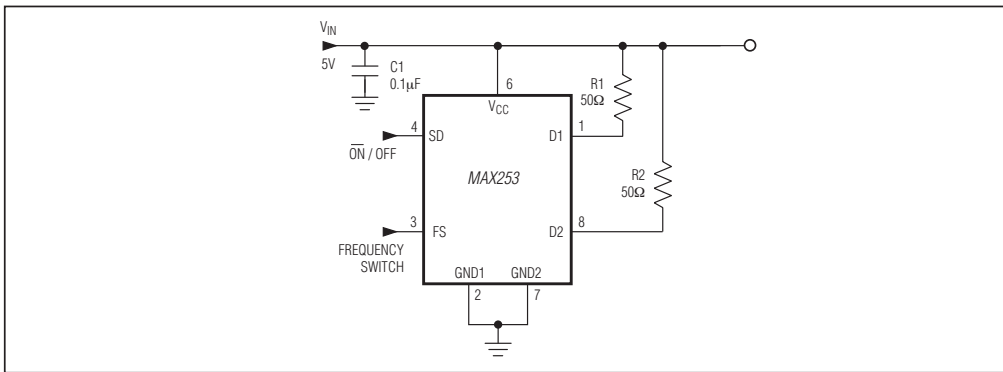
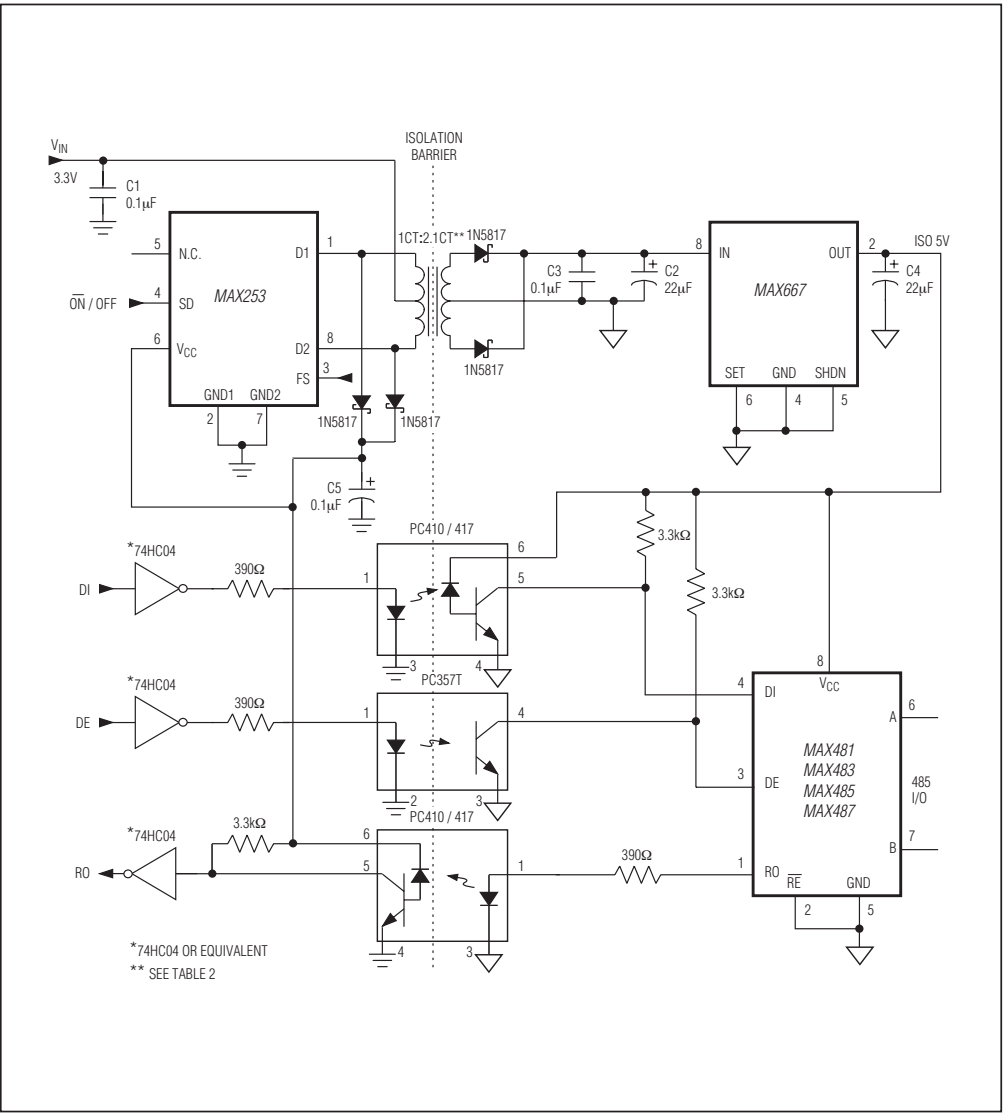
Most engineers first reach for the MAX253 when building isolated RS485 interfaces. Pair it with a low-dropout regulator, a center-tapped transformer, high-speed optocouplers, and a MAX48x-series RS485 transceiver, and you get a fully isolated link that withstands 1800VRMS transients—perfect for noisy factory floors or remote sensor installs. The circuit scales to full duplex too: swap the half-duplex MAX481/485 for MAX490/491 to hit 2.5Mbps, or use MAX483/487 with MAX488/489 for 250kbps links. Here’s the 5V configuration I’ve used in multiple industrial projects:
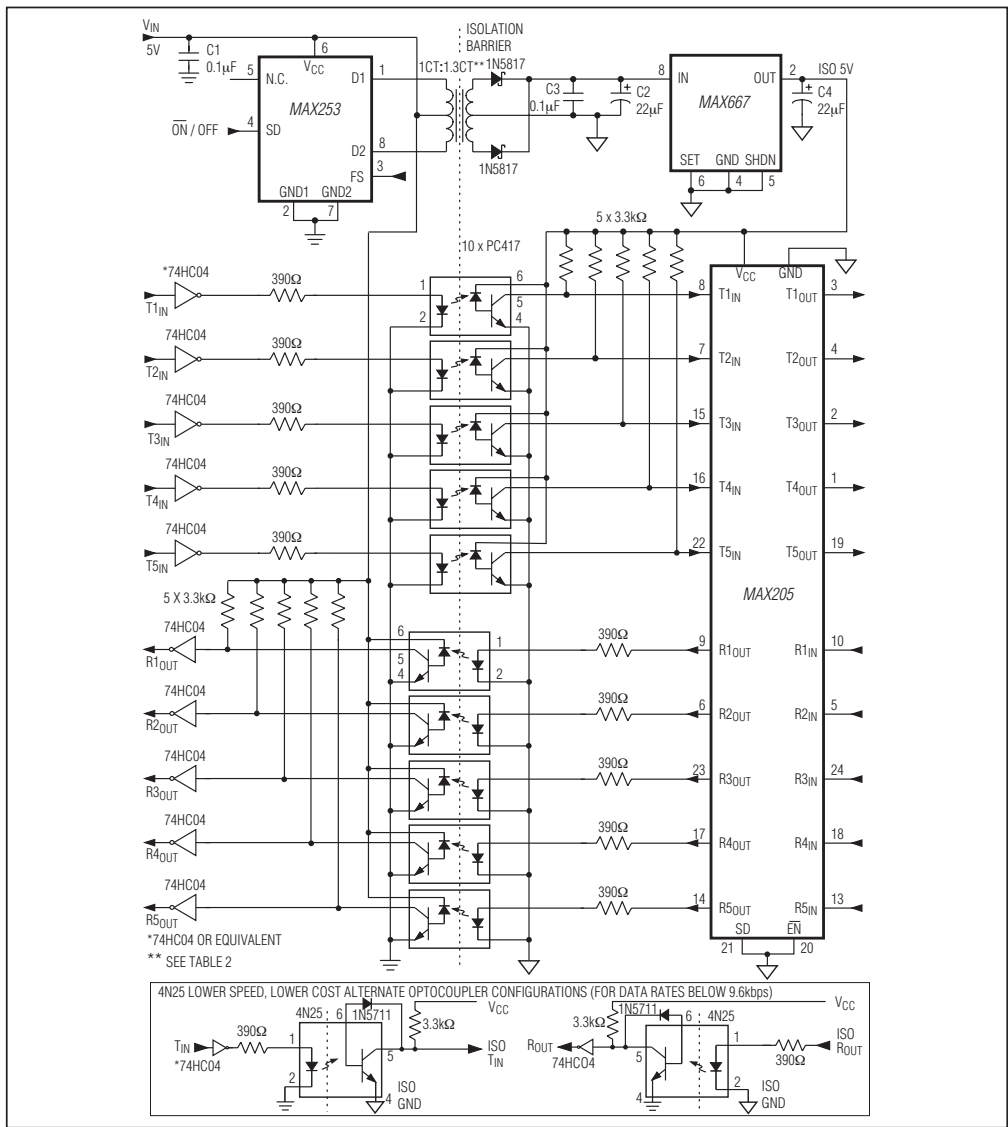
It’s not just for RS485 either. If your design needs isolated RS232 with more than four transceivers, the MAX253’s 1W output can drive 10+ devices at once. The classic 120kbps configuration uses Sharp PC417 optocouplers, or swap them for 4N25 parts to cut cost for 9.6kbps links. For 3.3V systems, just adapt the primary side to the boost configuration shown here:
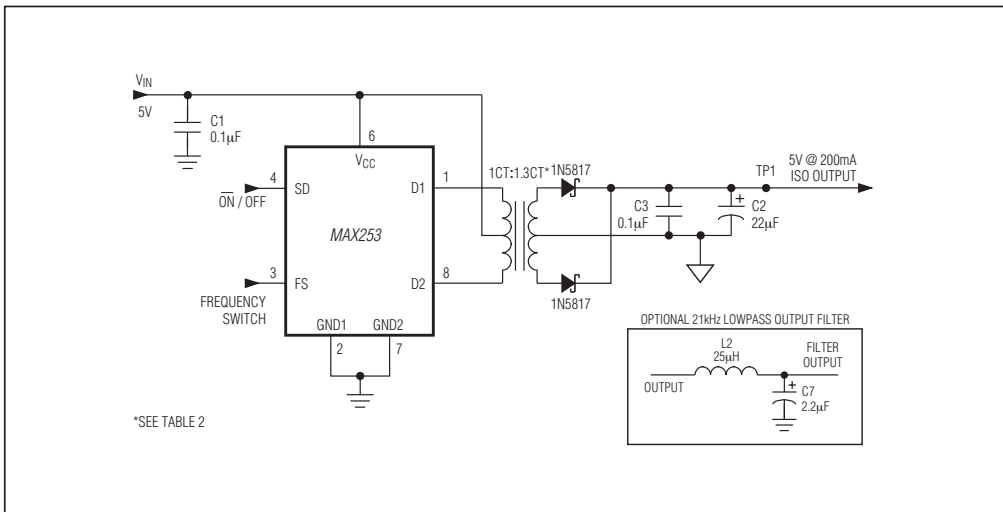
Beyond comms interfaces, the MAX253 makes a great general-purpose isolated power driver. Need 5V isolated from a 5V rail? The circuit below delivers up to 200mA with minimal ripple:
Running on 3.3V? Use the boost setup to nearly double your input voltage, giving ~600mW of isolated power:
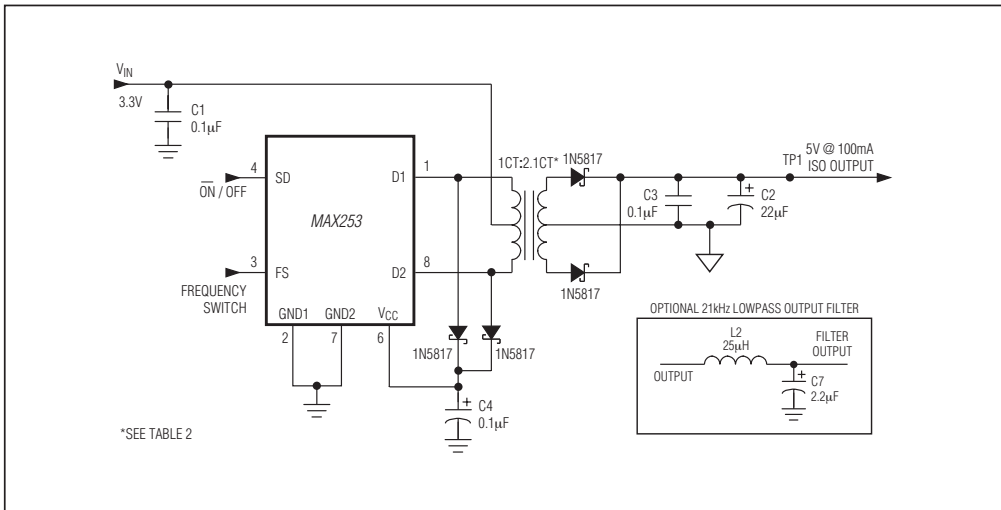
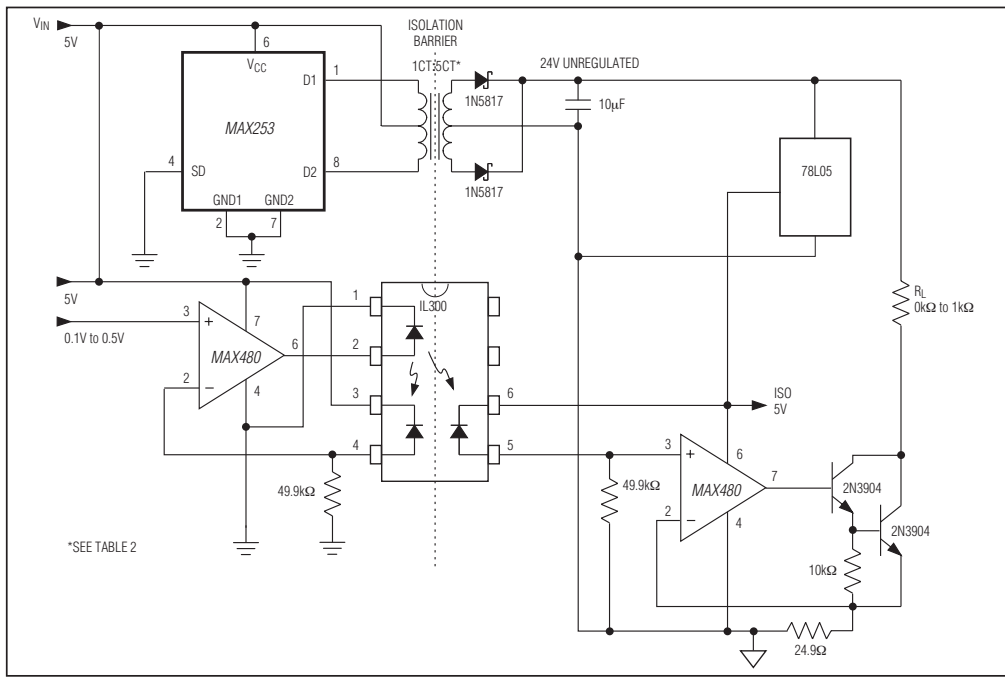
I’ve even used it for 4-20mA analog loops in process control—pair it with an IL300 linear optocoupler to isolate transducer signals without losing linearity:
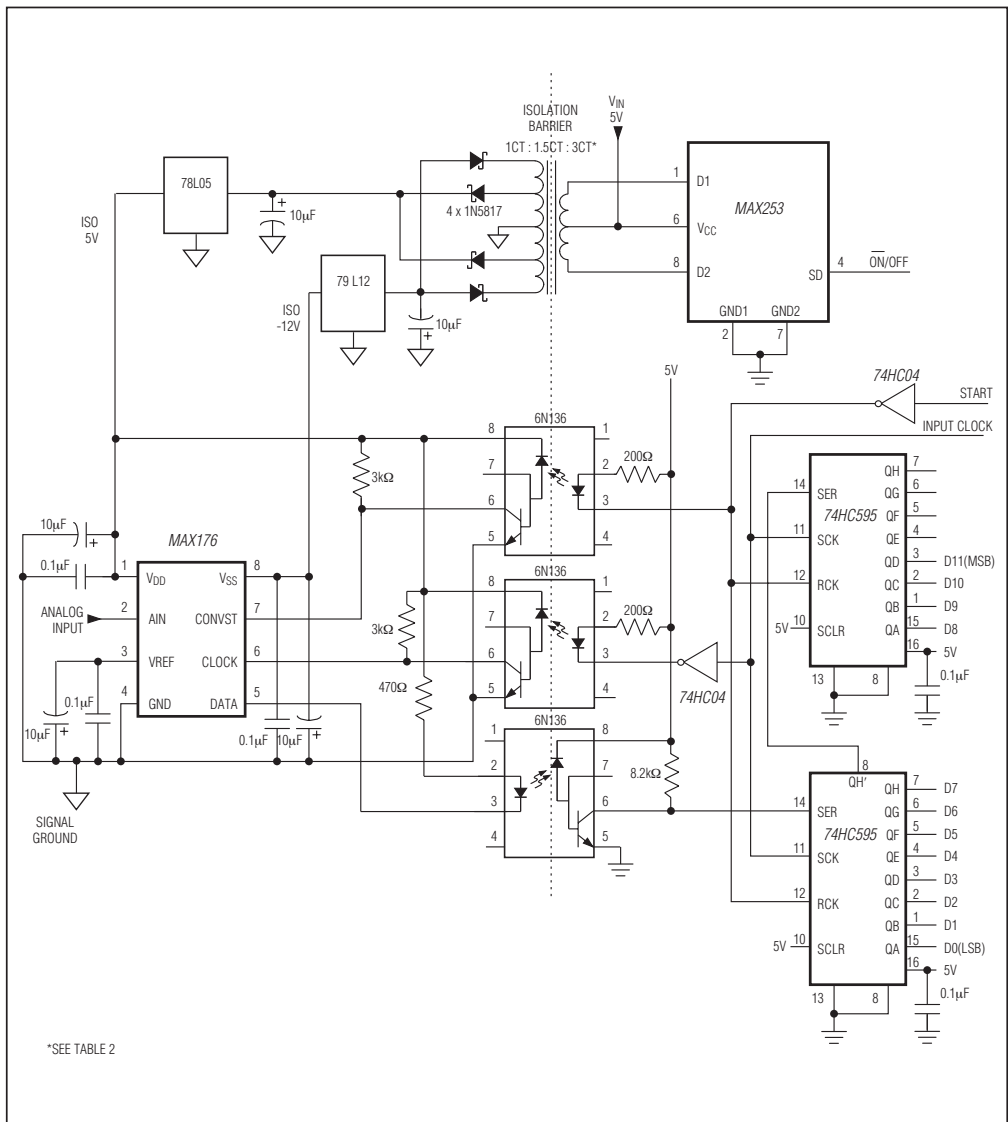
And if you need isolated ADCs, it can power multiple secondary rails for sensors and converters:
When picking parts for your MAX253 design, start with the transformer. You need a center-tapped primary with enough ET product to avoid saturation at the lowest selected frequency. For FS low (200kHz mode), the minimum frequency is 150kHz, so the maximum period is 6.67μs—calculate the required ET as VCC_max * (period/2). Stick to closed magnetic path cores like toroids or pot cores to cut radiated noise. Here are the typical specs I use for common configurations:
| DATA RATE | FULL DUPLEX RS485 IC | HALF DUPLEX RS485 IC | OPTOCOUPLER FOR DI/RO | OPTOCOUPLER FOR DE |
|---|---|---|---|---|
| 250kbps | MAX488/MAX489 | MAX483/MAX487 | PC417 | PC357T |
| 2.5Mbps | MAX490/MAX491 | MAX481/MAX485 | PC410 | PC357T |
Table 1 Optocoupler and RS485 IC Selection for Target Data Rates
| CHARACTERISTIC | 5V to ±10V | 5V to 5V | 3.3V to 5V | 5V to 24V | 5V to ±5V;±12V |
|---|---|---|---|---|---|
| Figure | 9a | 2,3,5,6 | 4,7 | 8 | 10 |
| Turns Ratio | 1CT:1 | 1CT:1.3CT | 1CT:2.1CT | 1CT:5CT | 1CT:1.5CT:3CT |
| Primary Windings | 44CT | 44CT | 28CT | 44CT | 44CT |
| Secondary Windings | 44 | 56CT | 56CT | 220CT | 66CT,132CT |
| Primary ET Product (FS Low) | 18.3V-μs | 18.3V-μs | 12V-μs | 18.3V-μs | 18.3V-μs |
| Primary ET Product (FS High) | 11V-μs | 11V-μs | 7.2V-μs | 11V-μs | 11V-μs |
Table 2 Typical Transformer Characteristics for Common Configurations
For diodes, go with fast-switching Schottky types—1N5817 works for through-hole, SB05W05C for SMT. Avoid half-wave rectification unless your load is perfectly balanced; full-wave rectification prevents DC flux imbalance that can saturate the core. If output ripple is a concern, add a π-filter (cutoff ~21kHz) to drop ripple to ~10mVp-p—just keep the inductor’s DC resistance low to avoid excess voltage drop.
Layout matters too: keep the isolation barrier clean—don’t run traces from the primary side near secondary components. Place optocoupler outputs as close as possible to the RS485/RS232 transceiver to minimize parasitic capacitance and preserve data rates.
Here are component suppliers I’ve had good luck with:
| Transformers | Transformer Cores | Optocouplers |
|---|---|---|
| BH Electronics | Philips Components | Quality Technology |
| Coilcraft | Magnetics Inc. | Sharp Electronics |
| Coiltronics | Fair-Rite Products | Siemens Components |
Table 3 Recommended Component Suppliers
After using the MAX253 in everything from medical patient monitors to oilfield sensor nodes, I can say it’s one of the most straightforward ways to add robust isolation to a design. It cuts out the complexity of designing a custom flyback or push-pull supply, and the low shutdown current makes it perfect for battery-powered gear. Just follow the transformer and diode guidelines, and you’ll have a reliable isolated power stage up and running in no time.