 3J LIMITED
Ultra Low Leakage Switching Diodes for Precision Circuit Design
When you’re deep into a precision analog or high-impedance sensor interface project, leakage current becomes the silent killer of accuracy. I’ve lost count of how many late nights I’ve spent debugging signal drift, only to trace it back to a diode with subpar reverse leakage. For designs where every picoamp matters—think medical instrumentation, industrial sensors, or long-term battery-powered monitors—the choice of discrete diodes isn’t trivial. That’s where ultra-low leakage switching diodes step in, and the CMPD6001 series has become a go-to in my toolkit for exactly these scenarios.
These surface-mount silicon diodes are built using an epitaxial planar process, optimized specifically for applications demanding minimal reverse leakage. What sets them apart isn’t just raw specs, but the flexibility of configuration: single diodes (CMPD6001), dual common anode (CMPD6001A), dual common cathode (CMPD6001C), and series-connected duals (CMPD6001S). This variety means you can pick the topology that fits your layout without compromising on performance. Marking codes are straightforward too—ULO, ULA, ULC, ULS for each variant—handy when you’re reworking prototypes and need to verify parts at a glance.
Let’s talk real-world limits. In typical 75V reverse bias conditions, leakage stays below 500pA at room temperature—a figure that holds up better than most general-purpose switching diodes I’ve tested. Breakdown voltage starts at 100V, so they handle transient spikes without flinching. Forward voltage is another practical win: at 100mA forward current, you’re looking at a max of 1.1V, which keeps power dissipation in check for small-signal paths. And with a junction temperature range from -65°C to +150°C, they won’t bail on you in harsh industrial environments.
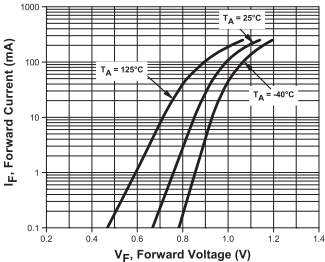
The thermal side is worth noting too. With 357°C/W thermal resistance, these aren’t meant for high-power rectification, but for their intended switching roles—signal routing, clamping, or isolation in low-current paths—they stay well within safe operating bounds. Power derating follows a predictable curve, so sizing for your ambient temp is straightforward.
In practice, I’ve leaned on the CMPD6001S (series dual) for RS-485 termination networks, where leakage could otherwise corrupt bus signals over long cable runs. The common-cathode (CMPD6001C) and common-anode (CMPD6001A) variants simplify bidirectional protection circuits—no extra PCB real estate wasted on discrete placements. For single-diode needs, the base CMPD6001 slots neatly into sample-and-hold circuits, where its 2pF max junction capacitance ensures fast settling without loading the input.
| Model | Configuration | Marking Code |
|---|---|---|
| CMPD6001 | Single | ULO |
| CMPD6001A | Dual, Common Anode | ULA |
| CMPD6001C | Dual, Common Cathode | ULC |
| CMPD6001S | Dual, In Series | ULS |
| Parameter | Symbol | Min | Max | Units |
|---|---|---|---|---|
| Reverse Leakage | IR | — | 500 | pA |
| Breakdown Voltage | BVR | 100 | — | V |
| Forward Voltage (1mA) | VF | — | 0.85 | V |
| Forward Voltage (100mA) | VF | — | 1.1 | V |
| Junction Capacitance | CJ | — | 2.0 | pF |
A few hard-won tips from the bench: avoid pushing continuous forward current beyond 200mA if you’re operating above 85°C ambient—thermal derating kicks in faster than you’d expect. For ultra-low leakage applications, keep PCB traces short and away from noisy power planes; even good diodes can’t compensate for poor layout-induced leakage. And if you need custom configurations, the manufacturer offers wafer diffusion options—saved me once when a client needed a non-standard pinout for a space-constrained wearable design.
If your next project involves high-impedance inputs, precision measurement, or any scenario where signal integrity hinges on minimal leakage, give this series a look. They’ve earned a permanent spot in my component library, not for flashy specs, but for consistent, reliable performance where it counts. Sometimes, the smallest parts make the biggest difference in keeping a design from becoming a debugging nightmare.